Rocket Companies just published a post about modernizing Rocket Mortgage Origination, and it is an incredible story about Claude Code usage in production. Not a demo, not a hackathon, a regulated mortgage platform that real clients use to verify income, e-sign disclosures, and upload financial documents. The numbers first, because they earned the top of the page:
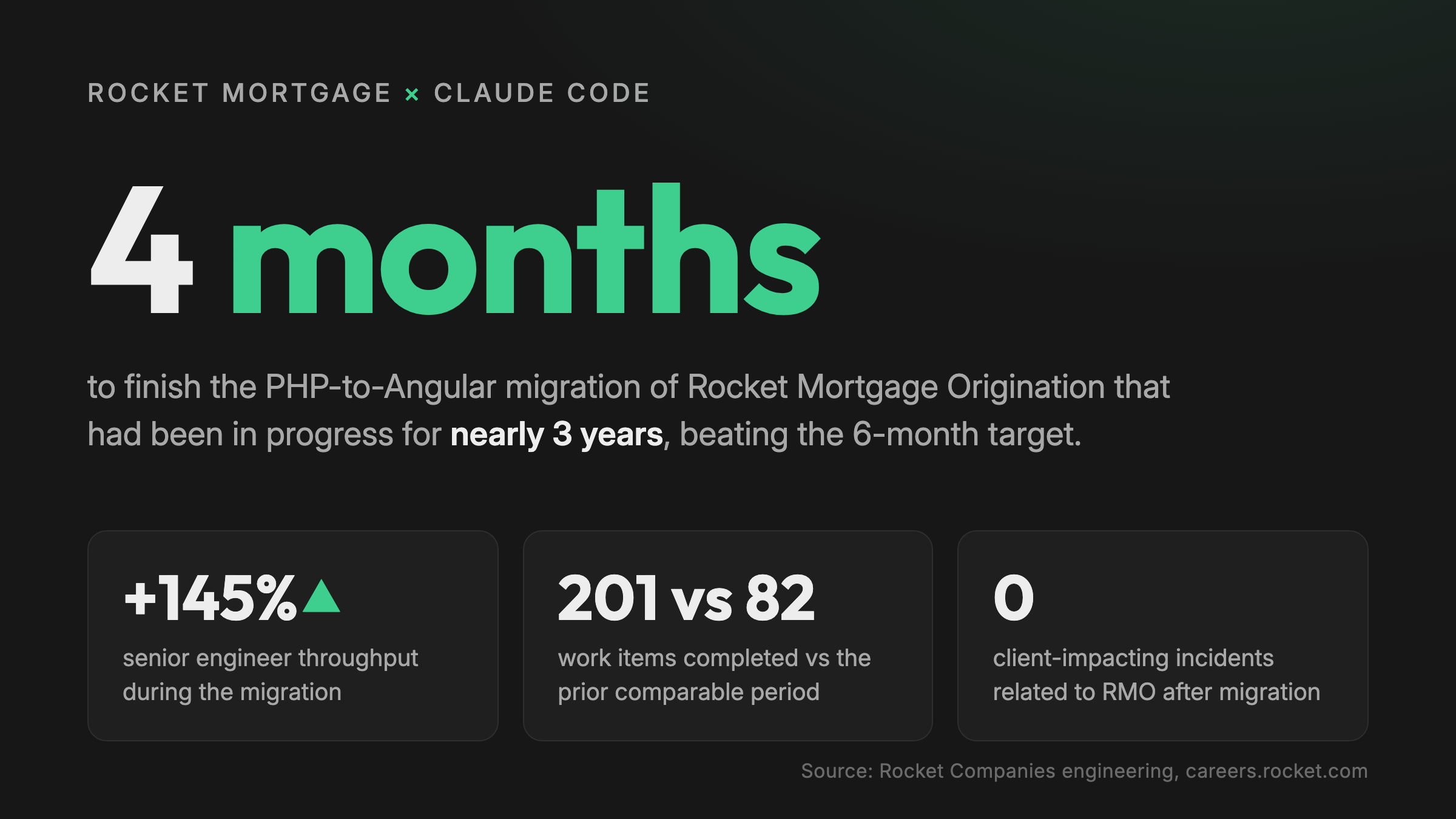
- 4 months to finish a PHP-to-Angular migration that had been in progress for nearly 3 years, ahead of their 6-month target
- 145% increase in senior engineer throughput: 201 work items completed vs 82 in the prior comparable period
- A measurable reduction in bugs and zero client-impacting incidents related to the platform after migration
Read the full post here: Accelerated modernization: Rocket Mortgage Origination, written by John Fair, SVP of Client Experience Engineering at Rocket Companies.
#The setup
Rocket Mortgage Origination is the client-facing side of getting a mortgage. It ran on server-side PHP that was nearing end of life, and the team had spent almost three years partway through a migration to Angular. Anyone who has lived in a hybrid legacy-plus-new codebase knows that state: every feature touches two worlds, and the finish line never gets closer.
Then Anthropic hosted a 2.5-day immersive workshop on agentic coding for the team. Four months later, including the training time, the migration was done.
#Why it worked (it was not magic)
The speed is the headline, but the discipline is the part worth studying. Rocket’s playbook:
- A shared
claude.mdcarrying architectural principles, coding standards, linting expectations, and test guidelines, so every engineer’s session ran under the same rules. - Architecture docs fed into context. They gave Claude the platform’s existing documentation instead of hoping it would guess the design.
- Existing PHP unit tests as the reference for refactoring logic into Angular, so correctness had a definition.
- A pair-programming loop, not a vending machine. Engineers asked questions about API calls and state management, reviewed and modified what Claude produced, and tested before committing. Human oversight on every change.
Two quotes from the team stood out to me:
“It felt like pair programming with a supercharged teammate. Claude didn’t replace our work; it helped us move through it faster and with more confidence.”
“It took a while to understand how to steer it. But once it clicked, productivity skyrocketed.”
That second one is the honest part most case studies skip. There is a learning curve, and Rocket paid it deliberately, with training, instead of letting each engineer bounce off the tool alone.
#The same playbook, at any scale
What strikes me most is that Rocket’s approach at enterprise scale is the same one I landed on as a solo builder. Last week I wrote about building Repo Recommender with Claude Code the disciplined way: a CLAUDE.md that steers every session, rules enforced by tooling, humans reviewing every change. Rocket ran the identical loop with a regulated mortgage platform and real clients on the line, and got a stuck three-year project done in four months with zero client-impacting incidents.
That convergence is the signal. When the same working method produces results for a solo side project and a regulated enterprise migration, it is a method, not a fluke.
If you run an engineering org and are still wondering whether agentic coding is real, read Rocket’s post. Write the rules down, give the model your docs and tests, keep engineers in the review loop, and invest in learning to steer. The numbers at the top of this page are what that discipline buys.